Thursday, 24 March 2011

"In all the world, there is no desolation more complete than the polar night. It is a return to the ice age -- no warmth, no life, no movement" -- from Endurance by Alfred Lansing.

The past few weeks have seen a lot of people leave the base. Quite a few good friendships had been forged over the four months I've spent on base, but one of the things I learned after living in Cambridge for a three years is that people come and people go. I've become used to saying goodbye and just getting on with things. The last of the planes left at the beginning of March, and now the ship has gone.

So here we are. Twenty people -- a motley crew of mountaineers, scientists, engineers, chefs and doctors -- left alone, not only on the base but quite likely the whole of Adelaide Island for the next eight months. The ship, Ernest Shackleton, left Rothera on Sunday 20th March 2011, taking the last remaining personnel from the summer season.

This years winterers had been invited on board the Shack on the Friday night for a meal. I hadn't realised at the time, but one of the luxuries that the crew of the Shack have been enjoying is milk. We have a powdered milk substitute on base which is an acquired taste -- so much so that most of the people on base have no intention of acquiring it. So when I got my first chug of real milk on the ship, I was very tempted to leave the base behind and stowaway.

So on to work. I've been left to my own devices since the end of February, when my predecessor, John Wedlake, left. It was an excellent handover, and if I'm honest, I've got my work cut out if I'm to do a good a job as he did. My job now, and for the next 8 months, is to keep the experiments running to the best of my ability. Most of the work is computer based, and the traditional IT Crowd-esque, "turn it off and turn it on again" is a good start. (This is a valid technique by the way!! NASA engineers call it "cycling the hardware") However, there have been a number of occasions where I've had to get down and dirty with cable impedance matching and other electronicy goodness. In my geeky heart of hearts, I know that this is where the fun lies!! I am by no means an expert in the systems here on base, but an old boss of mine once gave me some advice, "If you don't know how to fix something, there's bound to be somebody in the world who does!"

The nights began to draw in noticeably about a months ago. This meant that the sun actually dipped below the horizon for a few more hours each night, and the stars began to put on one hell of a show. There's an area of the base which is devoid of any man made light and by picking a good time, we can go up there and see the Milky Way in all its splendour. This is amazing to me -- I've grown up in and around Wrexham, and like most people living near towns and cities, we've grown up with light pollution. To see the stars in crystal clarity, as well as a host of meteorites and satellites, was amazing. Unfortunately, my camera skills are still next to nothing, so trying to capture what I've been seeing is almost an exercise in futility. But here's one attempt!

Saturday, 5 February 2011

"No more adventures" -- C-3PO

So they sent me away. I managed to spend a few weeks at Sky Blu Runway, a deep field station south of Rothera. This was part of the work I have been doing for a project run by Newcastle University, but through BAS, whereby a network of global positioning satellite receivers have been setup to monitor how the Antarctic surface moves over time. Sky Blu is a perfect location for me to base myself while flying out to these sites.

This summer only base is generally manned by only one or two people, who have the job of clearing the blue ice runway of any snow, in order for the BAS aircraft to land. For the small Twin Otter planes, and their fitted skis, snow is not much of a problem, but for the larger Dash 7, the clearing of the runway is essential. Weather at Sky Blu is harsher and colder than at Rothera, and living is definitely more basic, but there is something appealing about this "frontier" outpost. We were reliant on the aircraft for our food supplies, and found ourselves switching to possible 24hour work patterns in order to get jobs done to make this happen.

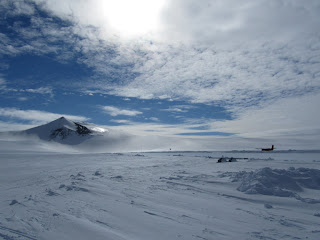
The base lies in the shadow of Mount Lanzarote, (shown in the photo) and is an area of nunataks: mountainous areas whose peaks just rise up above the snow. The base was set up around twenty years ago when a survey flight identified the blue ice area as a possible site for a runway in order to facilitate deep field science insertion. Since then the base has developed to accommodate three living and sleeping melon huts, two underground garages for the over-winter storage of vehicles, and a history of happy campers travelling to and from the deep field.


After a few weeks out there, waiting for the right conditions to get out to visit my sites, we finally managed to get the work done. Not only that, but we also managed to get a trip out to Site 8, one the field fuel depots on the Ronne Ice Shelf. These fuel depots are setup for the Twin Otters to refuel in the field, but get covered with snow over the course of the year. Our job was to go and uncover Site 8. Our triumph at moving the 20-odd full drums of aviation fuel to higher ground is amply captured in this photo.

And it has Winnie the Pooh too.*


(*Winnie the Pooh, the most well traveled bear in the world, courtesy of Mike "Smiler" Stainer)

Thursday, 6 January 2011

"That aint workin', that's the way you do it" -- Money for Nothing, Dire Straits.

I've been following the blog of my good friend, Andy Dixon, the wintering Met Tech over at Halley Research Station. Andy is an excellent communicator and has written some great pieces
about the science that BAS does over there. I thought I'd follow suit and write about some of the experiments that I am looking after here at Rothera.

Two of these experiments are radar systems. The Medium Frequency (MF) Radar and Skiymet are both looking at the way air moves in the middle and upper atmosphere. The three huge masts visible in the photo are three of the four corners of the square MF transmitter, which sends radio waves into the sky. When air parcels move past each other in the upper atmosphere, they rub and the resulting friction causes particles to become charged, or ionized. The radio waves from the MF reflect off these charged areas and three radio receivers, which are specifically tuned to pick up the MF waves, detect the reflected wave. By comparing which receiver received the reflected rays and in which order, the positions and directions of the charged air parcels can be calculated, and so the speeds and directions of winds high up in the atmosphere can be known. The Skiymet radar does a similar job, only this detects the ionised gas trails left by meteors as they enter Earth's atmosphere.

One of my favourite experiments around the base is the Very Low Frequency array of experiments. These detect the VLF radio waves generated naturally by lightning, or artificially by transmitters. When lightning strikes anywhere in the world, it emits radio waves with lots of different frequencies. Imagine your radio trying to play Radio 1, Radio 2, Virgin FM and good old Wrexham's Marcher Sound all at the same time. We hear that noise in Antarctica as a crackle as the radio waves travel from its point of origin and bounce up and down between the Earth's surface and the ionosphere -- that part of the Earth's atmosphere that is comprised of charged particles. Sometimes, a radio wave is produced that is so energetic that it can break through the ionosphere into space. When this happens it can return to the southern latitudes by travelling along Earth's magnetic field lines, and when it arrives, is can be detected. These particular energetic radio waves are known as 'whistlers' due to their characteristic sound when they are detected. By analysing the properties of the sound, information can be gathered about the region in which the radio wave traveled in, eg. outer space, prior to it being detected. As a result, the VLF experiments are used in world wide lightning location, and space weather prediction, amongst others.

More recently, I have had the chance to get out into the field to perform maintenance and data collection on an array of GPS receivers. These are part of an experiment set up by Newcastle University where by the motion of the snow and rock can be monitored over a long period of time. This work involved flying out to some spectacular sites for some spectacular sights and then trying to do as neat a job as possible with frozen fingers.

On a return journey from one of these sites, the pilot of our Twin Otter aircraft took us over some areas where melt pools had formed over the summer season. It was fascinating to see all these little rivers in the middle of the snow with their own little tributaries and ox bow formations. In the same area, we flew over something that reminded me of the mine remnants from back home in Wrexham, only here it had been formed by naturally occurring processes instead of human activity.

December has been busy, with my fellow electronics bod, John, off base. But all work and no play makes Ross a dull boy, so I've done my best to have some fun. A few of us organised ourselves into a band for New Years Eve, and along with three fantastic sets from DJ Wedders, DJ Bowen and DJ Haymaker, a good night, and morning was had by all. The band, The Dominic Savage Experience, consisted of myself, Fraze "Axl Rose" Prescott, Riet "Keith Moon" Van de Velde, and of course, the legend that is Sir Dom Savage.

Saturday, 25 December 2010

"It's Chriiiiiissssttmaaaas" -- Noddy Holder

Just a quick one!!!

To all those that come and
To those that leave;
To those that are taken
And leave us bereaved;
To the many who linger and
Those who ultimately stay
By the carrier pigeon, phone
Or computer each day;
To those who are always
at the end of a line;
To tell us that everything
Will be just fine;
To those that chuckle and
to those that laugh
At this hastily written
And bad epitaph;
To those that have raised
A drink to their friends
And give a smile and a wink with the
thoughts that they send,
I hope that good things all come to pass
On this, a very merry Christmas!!
---Ross, Antarctica

Sunday, 21 November 2010


"Come dance this silence down through the morning" -- Mr Jones, Counting Crows

I have a checklist of things I wanted to see while I was in Antarctica. Penguins and whales were two of the principle items. I've been here less than a month and I can already tick them off.

Take this little bugger for example. We rounded a corner on a walk around Rothera point, and found Pingu here lying around posing. Not a care in the world, and just waiting for his picture to be taken.

This may have been the same penguin that appeared near the runway a few days ago, but I never got this close to him then. Today, there were four or five of us armed with cameras, and he was more than willing to oblige.

This fella was a little less photogenic, as he was lumbering his way along the ice's edge while we were trying to get a snap of him. I believe it's a Weddell seal , but my knowledge of the local wildlife is currently slim at best.

The base is littered with various species of seals such as the Weddell seal, Leopard seal, and the Jabba-The-Hutt-esque Elephant Seal. All of them seem to be a cruel joke of nature when seen on the ice. They seem to exert tremendous effort to hurl their entire bodies a few inches along the ground. I am told, however, that they come into their own under water and are incredibly elegant.

We diligently observe a "five meter rule" when approaching wildlife. This was taken to the extreme when I had my first glance of a pod of Orca off in the distance.

I'm slowly learning to keep my camera on me more often.


Wednesday, 17 November 2010


"D'you know, I put so much petrol in me car the other day, I couldn't get in!" - Vic Reeves

I've been in Rothera for about ten days now, getting to grips with daily routine, doing essential training and observing some fantastic scenery and wildlife. I saw my first penguin the other day. It was an Emperor, which is apparently quite rare in these parts. It stayed for hours in the same place, stood up at some times, then belly flopping down into its tobogganing position. I suppose I'll get blasé about all this one day, but I hope it's not too soon.

I am finding it a bit hard to concentrate at the moment. I received some bad news from back home, which I would be remiss not to mention. One of my oldest and dearest friends, Karl Jones, passed away two days ago. We grew up together, went to school together, and when I first moved away from home, we shared a house together. This news is quite cutting, and despite the grief, I agree with the people who tell me to concentrate on all the happy memories we shared together. Like him being the first person to use the words "Obi Wan Kenobi" in my presence when we were kids, so anyone who gets tired of my Star Wars obsession knows where it comes from. Or the times we spent playing Goonies 2 on Nintendo, and I just couldn't work out how to flick that yo-yo. Or more recently, the time we went and
pestered for our photo to be taken with some guy in the pub who bore an uncanny resemblance to Rick Parfitt. There were a lot more, but boys will be boys and some tales are best kept between few people!!! I appreciate the fact that grieving is a personal thing, and some people may not agree with the fact that I've mentioned my friend here, but I feel that this huge hearted person, who once told me "my friends are worth more than gold to me", could never be given the mentions he deserves, even if tomes were written by each of his many many friends. I will miss him very, very much.


Wednesday, 3 November 2010

"Zero hour....9 am" -- Rocketman, Elton John (but in this case, the William Shatner version)

Here it is then. I leave the UK tomorrow afternoon, and so leave sunny Wrexham in the morning. I've said my goodbyes to friends and family, sorted out documents, packed my bags, and booked train tickets.

I've spent the last couple of weeks on embarkation leave, or "sort your life out" leave, so most of that has been spent in North Wales, getting in as much of the colour green as I can. Pre-deployment training ended well with a lot of climbing up electricity pylons as preparation for climbing up radar masts. The above photo belongs to Emma Philpott, and was taken during one of our mast climbing days down in Somerset.

Coed Llandegla is a great place to go in North Wales if it is necessary to soak up some nature before, say, going on some sort of mad polar journey. I spent a bit of time wandering around the area and annoying passers by with my camera.

Ah well, they can't catch me now.